Your cart is empty
Tax included and shipping calculated at checkout
Drawer menu
Tax included and shipping calculated at checkout

Last Updated: November 2, 2026
Quick Summary
The best pregnancy safe skincare bundle for breakouts is one with a gentle cleanser, a fragrance-free moisturizer and daily mineral sunscreen, plus a treatment step only after your clinician confirms its ingredients. Hormonal breakouts during pregnancy are not cured by any bundle, so judge the routine over several weeks.
Pregnancy changes hormone levels, and for many women that shift shows up on the skin as breakouts along the jawline, chin and cheeks. MProve Body develops its pregnancy and postpartum products with a board-certified OB/GYN, so the approach here starts with what a bundle can and cannot do.
A skincare bundle can simplify a routine. It cannot switch off the hormonal changes behind the acne. Treat the bundle as a way to keep cleansing, spot care and moisturizing consistent, not as a cure.
Acne often takes several weeks to respond to any change, so judge a routine over time rather than after a few days. American Academy of Dermatology guidance on acne
Start by reading the full ingredient list rather than the front of the box. Many women rely on general labels such as "natural" or "clean," which tell you little about pregnancy suitability. Learn why salicylic acid is avoided during pregnancy. A bundle is only as useful as its ingredient list, so treat the label as the first filter, not the last.
Check with your OB/GYN or midwife before adding any new active ingredient. This matters most in the first trimester, when many clinicians prefer to keep routines simple. The goal is not to find a single "safe" list that applies to everyone, but to understand which ingredients are commonly avoided, which are often considered options, and when to confirm use with your clinician.
Much of the pregnancy skincare guidance is based on caution and limited data rather than large trials, which is why recommendations vary between clinicians. A common pattern is to keep the routine simple, avoid the ingredients with the clearest risk signals, and introduce anything new one product at a time. NHS guidance on skincare and sun protection in pregnancy
Skin and treatment questions change across pregnancy. In the first trimester, many clinicians prefer the simplest possible routine while the pregnancy is being established. In the second and third trimesters, oiliness and breakouts often shift, and some women find their skin becomes more sensitive or more dry. A bundle that suits one trimester may need adjusting in another, so check the ingredient list again if your skin changes or your clinician updates their advice.
Look for gentle, well-tolerated basics first: a mild cleanser, a fragrance-free moisturizer and a daily mineral sunscreen. Then add a treatment step only once you have confirmed its ingredients with your clinician.
Some acne ingredients are commonly avoided in pregnancy, and it is worth knowing which ones before you buy. The reason is usually a combination of known risk, limited data, and the fact that skin can be more reactive during pregnancy. Ask your clinician whether a given ingredient suits your stage of pregnancy.
Retinoids (retinol, tretinoin, adapalene, and prescription retinoid creams) are generally not used during pregnancy. The concern comes from the known risk associated with systemic retinoids, and most clinicians advise stopping topical retinoids once pregnancy is confirmed. On a bundle label, look for any "retinoid," "retinol," or "retinal" ingredient and treat it as a reason to check with your clinician before use.
Salicylic acid is the acne ingredient most often flagged in pregnancy. Oral salicylic acid is avoided, and many clinicians also advise caution with leave-on topical salicylic acid at higher concentrations. A brief, low-concentration wash is sometimes considered, but this is a clinician decision rather than a default. Check bundle labels carefully, and note the concentration and whether the product is a rinse-off wash or a leave-on treatment.
Many clinicians also advise caution with strong chemical exfoliants, including high-percentage glycolic or lactic acid peels and professional peels. The evidence in pregnancy is limited, and the skin can be more reactive, so a gentle approach is usually preferred. Low-concentration, rinse-off or occasional-use formulas are a different conversation from a high-strength peel, so read the concentration and frequency rather than the front-of-pack claim.
Hydroquinone is often avoided in pregnancy because of limited data, even though it is a common melasma treatment outside pregnancy. Compare glycolic acid and lactic acid during pregnancy. If a bundle includes a brightening step, check whether hydroquinone is listed and confirm with your clinician before use.
These are not proven harmful in the same way as retinoids, but they are a common trigger for irritation and contact dermatitis, which can look like a breakout. A fragrance-free, essential-oil-free formula is often a more predictable choice for sensitive or changing skin.
Pregnancy-safe acne treatment options are limited and depend on your stage of pregnancy, so a clinician should guide any change beyond gentle skincare.
The table below sums up the ingredients this article flags as commonly avoided in pregnancy and the reason given for each.
| Ingredient | Why it is flagged | Action |
|---|---|---|
| Retinoids | Known risk with systemic retinoids | Check with clinician before use |
| Salicylic acid | Oral form avoided; caution with higher topical strengths | Confirm concentration with clinician |
| Strong chemical exfoliants | Limited evidence; skin more reactive | Prefer gentle approach |
| Hydroquinone | Limited data in pregnancy | Confirm with clinician before use |
| Fragrance and essential oils | Common trigger for irritation | Choose fragrance-free formulas |
A useful comparison puts each bundle's contents next to the others and looks at the same three questions: what each product does, what it contains, and whether it fits your stage of pregnancy. Lay out the cleanser, treatment and moisturizer for each option, then check every ingredient against your clinician's advice.
The cleanser should remove oil and sunscreen without stripping the skin. The treatment step is where most breakout products differ, so confirm its ingredients before anything else. The moisturizer keeps the barrier intact, which matters because dry, irritated skin can look like more acne.
MProve Body has not published pricing in the information available for this article, so pricing depends on the bundle, quantity and delivery. Check the current price on MProve Body's website, then work out cost per use by dividing the price by how many days the product will last at your routine's frequency. Confirm refill availability before you buy, so you know whether the routine can continue without a gap.
A simple routine works better than a long one. Cleanse once or twice a day with a gentle product, apply a spot treatment only if your clinician approves the ingredient, and finish with a fragrance-free moisturizer and daytime sunscreen.
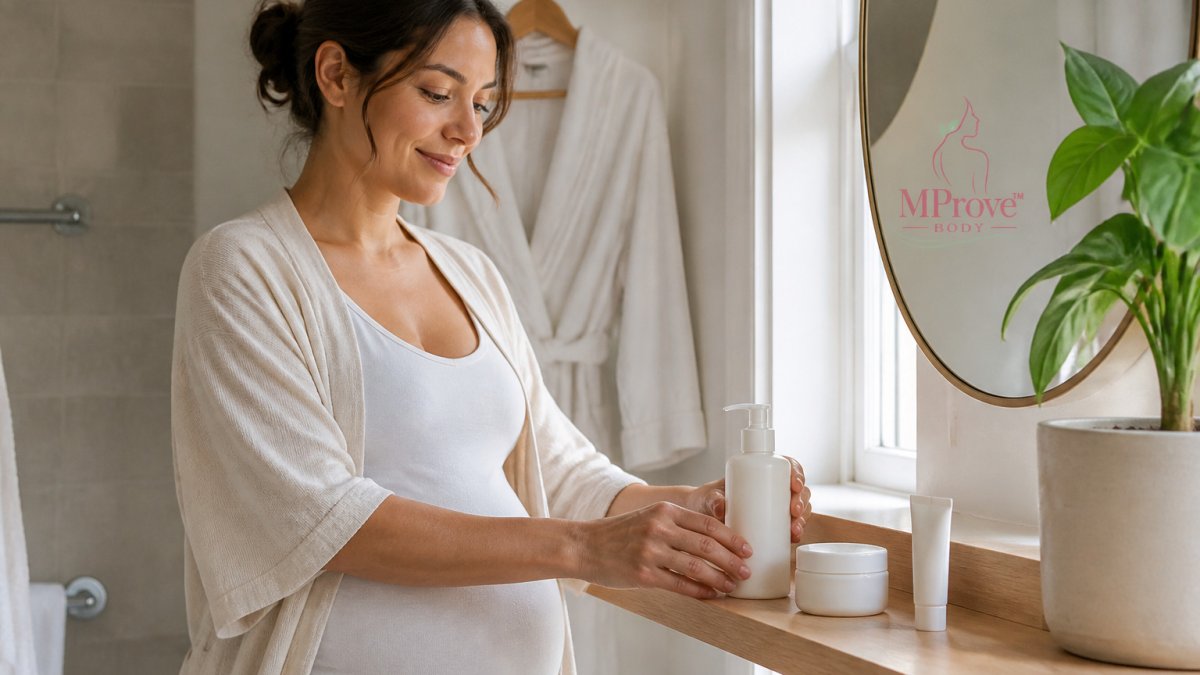
Introduce one product at a time over about a week. If irritation appears, stop the newest product and keep the rest. This makes it much easier to tell what is causing a reaction.
Adjust your routine if breakouts become painful, spread quickly, or are accompanied by redness, swelling or any other change that worries you. Contact your OB/GYN or midwife rather than adding stronger products on your own.
Pregnancy-safe acne treatment options are limited and depend on your stage of pregnancy, so a clinician should guide any change beyond gentle skincare.
If you decide a bundle suits you, review its full ingredient list against your clinician's advice before opening it. See the contents of The Signature Trio and check each product before you buy. Start with the cleanser and moisturizer, then add the treatment step only once your clinician has confirmed it is suitable.
Keep notes on how your skin responds over the first few weeks, and bring them to your next appointment. Ask any questions about specific ingredients before continuing.
Salicylic acid is one of the most discussed ingredients in pregnancy skincare, and the guidance is not uniform. Many clinicians advise limiting use to low concentrations applied to small areas, while avoiding high-strength peels. Because product strength and use pattern matter, check the concentration on the label and ask your OB/GYN or dermatologist before using any leave-on acid, especially in the first trimester.
Ask your doctor if breakouts are painful, spreading, crusting, or not improving after several weeks of a gentle routine. Sudden changes in skin, such as rapid new lesions or significant swelling, also warrant a visit. Your OB/GYN can tell you which treatments fit your stage of pregnancy and whether a referral to a dermatologist is appropriate.
A gentle cleanser, a non-comedogenic moisturizer and carefully chosen spot treatment can reduce irritation, but they do not change the hormonal shifts behind them. Expect gradual improvement rather than fast results, and introduce one new product at a time so you can tell what your skin is reacting to.


