Your cart is empty
Tax included and shipping calculated at checkout
Drawer menu
Tax included and shipping calculated at checkout

Last Updated: November 3, 2026
Quick Summary
To buy a pregnancy-safe skin recovery balm, check the full ingredient list for barrier supporters like shea butter, jojoba oil, and squalane, and skip retinoids, high-dose salicylic acid, and undisclosed fragrance. Run the list through a pregnancy-safe skincare checker, then patch-test on your inner forearm for a day before using it on tender areas.
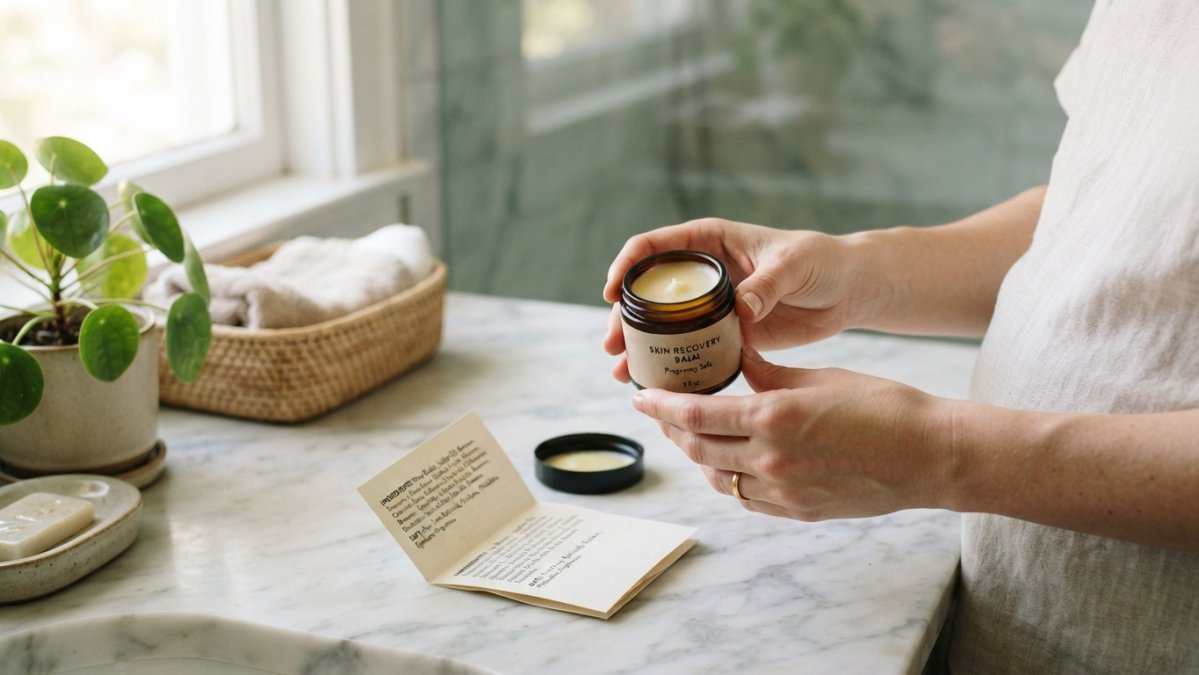
A skin recovery balm is a concentrated, oil-and-wax-based topical that seals moisture into the skin and cushions areas that stretch, rub, or crack during pregnancy and the postpartum weeks. Mothers often describe the same problem: lotions disappear within an hour, but the tightness and tenderness return. A balm stays put.
That staying power matters most in late pregnancy, when the belly, hips, and breasts pull against skin that cannot keep pace. It matters again after delivery, when nipples meet a newborn's latch many times a day with no time to recover between feeds.
A balm does a job a moisturizer cannot. Below, we explain which ingredients earn a place in a pregnancy-safe formula, which to question, and how to check a label before you pay.
Pregnancy-safe balm ingredients fall into two groups: barrier supporters that hold water in the skin, and actives that calm or soften it. The safest formulas lean on the first group and use a short, readable ingredient list. The American College of Obstetricians and Gynecologists' patient guidance on skin changes in pregnancy is a sensible starting point for understanding what is normal and what deserves a call to your clinician.
Here is the rationale ingredient by ingredient, so you can judge a label rather than trust a badge.
Barrier ingredients are the workhorses: they sit on the surface, slow water loss, and soften dry, stretching skin.
A common pattern is that the most protective balms combine one occlusive butter, one lighter oil, and one soother. That trio covers sealing, spreading, and calming without a long ingredient list.
Some ingredients are not worth the risk while pregnant or breastfeeding; others simply have no place in a product you may apply several times a day. "Avoid" means a real safety question; "question" means it may be fine but deserves a conversation with your clinician.
Retinoids and retinoid derivatives: check with your clinician before using any retinol, retinyl palmitate, or adapalene product.
High-dose salicylic acid: ask your clinician before using a leave-on salicylic product on the belly or breasts.
Synthetic fragrance and essential oil blends: frequent triggers for sensitive skin and irritation.
Undisclosed "parfum": a catch-all that hides what is actually in the formula. If a brand will not tell you what is in the fragrance, you cannot check it against anything.
If a label lists an ingredient you do not recognize, look it up before you buy. For a deeper breakdown, read our guide to choosing safe pregnancy skincare ingredients.
Watch out: "natural" and "clean" are marketing terms, not safety categories. Read the actual ingredient list rather than the front of the jar.
A pregnancy-safe skincare checker cross-references a product's ingredient list against known risk categories for pregnancy and breastfeeding. It does not replace your clinician, but it catches obvious problems fast.
Run every product through the same five steps:
Watch out: a green score is not a safety guarantee. Treat the result as a filter, not a verdict.
Our step-by-step walkthrough on using a pregnancy-safe skincare checker shows exactly where to find an ingredient list and how to read the flags.
A balm and a moisturizer do different jobs, and most pregnant and postpartum skin needs both. A moisturizer adds water and humectants; a balm sits on top and locks that water in. Skip the moisturizer and the balm has little to hold; skip the balm and the moisturizer evaporates within the hour.
| Factor | Balm | Moisturizer or Lotion |
|---|---|---|
| Main job | Seals in moisture, cushions skin | Adds water, softens surface |
| Texture | Thick, waxy, concentrated | Light, fluid, fast-absorbing |
| Best for | Nipples, cracked skin, targeted dry patches | Daily all-over hydration |
| Frequency | As needed, often after feeds | Morning and evening |
| Finish | Protective film | Absorbs fully |
Use a balm where skin is thin, tender, or under repeated friction. Use a moisturizer or cream-serum across larger areas like the belly and thighs. If you want one product for both jobs, a lightweight cream-serum bridges the gap better than a heavy butter.
StriaeMend | Stretch Mark Therapy Cream →
A pregnancy-safe skin care routine is simpler than the shelf at the pharmacy suggests: cleanse gently, hydrate, then seal. The order matters more than the number of products.
Keep the routine short. Every extra product is another ingredient list to check, and sensitive skin does better with fewer variables. Our guide to building a pregnancy skincare routine walks through how a balm fits alongside cleansing and hydration.
Pregnancy-safe skincare for hyperpigmentation and stretch marks relies on gentle, consistent hydration rather than aggressive actives.
For stretch marks, the practical goal is comfort and the look of texture. StriaeMend™ Stretch Mark Therapy Cream is a lightweight cream-serum built with Centella Asiatica, Hyaluronic Acid, Niacinamide, Shea Butter, Cocoa Butter, Jojoba Oil, and Squalane. It is designed for use during pregnancy, after delivery, and throughout life's natural body changes, and it glides over larger areas of stretching skin without a heavy or greasy residue.
For targeted guidance, see our article on treating melasma during pregnancy safely.
Before you buy, run the label against these checks.
Full ingredient list is published, not just "key ingredients"
No retinoids, hydroquinone, or undisclosed fragrance
Texture suits the area: light for large areas, rich for nipples and cracked skin
Jar size and price work out to a sensible cost per use
Return policy covers a reaction, since patch-testing only goes so far
Most roundups show a row of products without saying how they were judged. Here is the framework we use, so you can apply it to any brand:
Sticker price tells you little. What matters is how long a product lasts given where you apply it.
A larger tub often lasts longer per week than a small tube, even if the upfront number is higher. To compare fairly, divide the size by your estimated number of applications, or note how many weeks a given size will last for your specific use.
Watch out: a low cost per ounce is not a bargain if the texture means you need a thick layer to feel any effect. Spreadability and coverage matter as much as the number on the label.
A recovery balm is a cosmetic product. It can help with dry, tight, or chapped skin. It does not replace a prescription. If you have a persistent rash, cracked and bleeding skin, a wound, or severe irritation that does not settle, see a qualified clinician rather than swapping products.
Patch-test any new balm on the inner forearm for a day before applying it to tender areas. If you have reacted to a "natural" product before, introduce one new item at a time so you can identify the cause.
Our PureLatch | Botanical Nipple Balm is built for the breastfeeding stage: a plant-based blend of olive oil, coconut oil, shea butter, cocoa butter, sunflower oil, jojoba oil, marshmallow, chamomile, and vitamin E. It is lanolin-free, OB/GYN formulated, and designed for pregnancy and postpartum care. If you are stocking a full kit, The Signature Trio bundles our core essentials in one purchase.
Yes, with the right formula. Choose a balm with simple, botanical ingredients and no lanolin if you are sensitive to it. PureLatch Botanical Nipple Balm is lanolin-free and made with olive oil, coconut oil, shea butter, and chamomile for tender nipple and areola skin. Apply a small amount after nursing or pumping. If you are unsure about any ingredient transferring to your baby, ask your lactation consultant or OB/GYN before use.
Check with your provider before using retinoids or high-dose salicylic acid products. Check labels for fragrance-free and retinoid-free claims. If a product lists an active you do not recognize, look it up in a pregnancy-safe skincare checker or ask your provider.
Read the full ingredient list, not the front label. Look for fragrance-free, retinoid-free, and lanolin-free claims where relevant, and check whether the brand explains why each ingredient is included. StriaeMend Stretch Mark Therapy Cream was created by a board-certified OB/GYN and is designed for pregnancy, postpartum recovery, and beyond.


