Your cart is empty
Tax included and shipping calculated at checkout
Drawer menu
Tax included and shipping calculated at checkout

Last Updated: November 19, 2026
Quick Summary
A natural nipple balm is safest when it uses a short, named list of plant-based oils, butters, and waxes, and avoids petroleum, added fragrance, drying alcohols, and unclear preservatives. Check whether it is lanolin-based and how it is purified, and patch test on your inner forearm before nursing use.
A natural nipple balm is a topical product made from plant-based oils, butters, and botanical extracts, designed to moisturize and protect tender nipple skin during breastfeeding.
At MProve Body, products are formulated by a board-certified OB/GYN with a background in chemistry.
Safety depends on which ingredients, at what concentration, on which skin, and how often. If you are weighing whether a non-toxic formula is worth the spend, our breakdown of whether non-toxic nipple cream is worth it covers that decision.
The ingredients most worth avoiding in a nipple cream are petroleum-derived occlusives, added fragrance, drying alcohols, and certain preservatives. None are automatically dangerous, but each carries a trade-off worth understanding.
Petroleum jelly creates a strong seal that holds moisture in, but it sits on the skin rather than absorbing and offers no botanical soothing agents.
Fragrance is the ingredient most likely to trigger a reaction on already-compromised skin. "Fragrance" or "parfum" can stand for dozens of undisclosed compounds, making a reaction hard to trace.
Alcohol serves as a solvent or quick-drying carrier. On dry, cracked skin, it can sting and contribute to further dryness. Watch for denatured alcohol high in an ingredient list.
Preservatives are not the villain they are often made out to be. Any product containing water needs one, or it becomes a breeding ground for microbes. The question is which preservative and how much.
If a label lists parabens, formaldehyde releasers, or a long preservative cocktail in a product that also contains water, ask why the water is there.
Broad "natural" or "organic" claims tell you almost nothing about how a specific ingredient behaves on damaged nipple skin or what happens if a trace reaches a baby's mouth.
| Ingredient | Why it is in the balm | Benefit on tender skin | Caution to weigh |
|---|---|---|---|
| Beeswax | Structure and barrier | Forms a breathable protective layer that helps skin retain moisture | Rare contact sensitivity; not suitable for vegan formulas |
| Olive oil | Emollient base | Rich in oleic acid; softens and conditions dry skin | Some sensitive skin reacts to oleic-acid-heavy oils |
| Coconut oil | Emollient base | Lauric acid content; spreads easily and absorbs well | Can be comedogenic for some; patch test if prone to clogged pores |
| Shea butter | Butter/occlusive | High in fatty acids; cushions and soothes cracked skin | Nut-derived; avoid with a known tree-nut allergy |
| Cocoa butter | Butter/occlusive | Creates a protective film and improves spreadability | Cocoa is a potential allergen for a small subset of people |
| Sunflower oil | Light carrier oil | Linoleic acid supports the skin barrier; generally well tolerated | Cold-pressed versions retain more of the beneficial fractions |
| Jojoba oil | Wax ester | Closely resembles human sebum; absorbs without heaviness | Rare but possible sensitivity |
| Lanolin | Occlusive wax | Long history of protecting cracked nipples | Wool-derived; purification grade matters; contact sensitivity possible |
| Marshmallow root | Botanical extract | Traditionally used for soothing and softening | Herbal extracts can be contact allergens for some |
| Chamomile | Botanical extract | Known for calming properties | Asteraceae-family allergy (ragweed, daisy) is a real cross-reaction risk |
| Vitamin E | Antioxidant | Helps preserve the oil blend and supports skin | Topical vitamin E can irritate a minority of users |
| Essential oils | Scent and botanicals | Aromatic; some have traditional soothing use | Concentrated; a common source of contact reactions on broken skin |
Two patterns stand out. First, the ingredients that do the most work are usually the plainest: oils, butters, and waxes that moisturize and seal. Second, the ingredients most likely to cause trouble are added for scent, preservation, or a marketing story rather than skin function.
Watch out: "fragrance-free" and "unscented" are not the same claim. An unscented product can still contain a masking fragrance, so check the full ingredient list rather than the front label.
If a label fails on several of these points, keep looking. For a fuller walkthrough of vetting a balm before purchase, our guide to checking a nipple balm before you choose expands each point.
Lanolin nipple cream safety is one of the most misunderstood topics in breastfeeding care.
The concern is not lanolin itself but what remains in it. Wool can carry pesticide residue, and some people develop contact sensitivity over repeated exposure. Highly purified, pharmaceutical-grade lanolin is processed to remove most impurities, and many mothers use it without issue.
Two practical points follow. If you have a wool allergy or a history of sensitive skin reactions, a lanolin-free formula removes the variable entirely. But "lanolin-free" is not a quality claim in itself, a lanolin-free balm still needs a well-chosen base of oils and butters.
Nipple balm safe for baby use is best judged by what actually reaches the infant. A thin layer on the nipple and areola means a small amount of residue may contact your baby's mouth at the next feed. The relevant question is whether those ingredients are appropriate for incidental oral contact, not whether they are "chemicals."
PureLatch is built from olive oil, coconut oil, shea butter, cocoa butter, sunflower oil, jojoba oil, and vitamin E. Botanical extracts such as marshmallow and chamomile are included for their soothing properties.
That said, the answer depends on the formula, not the category. If a product contains fragrance, a preservative system you are unsure about, or an ingredient your baby has reacted to, remove it before feeding. Apply balm after nursing or pumping so the skin can absorb it before the next feed. For a deeper look at which creams are considered safe during nursing, see our guide to safe nipple cream for breastfeeding.
PureLatch was formulated by a board-certified OB/GYN with a background in chemistry, and is designed for pregnancy and postpartum care. The ingredient list is short and plant-based: olive oil, coconut oil, shea butter, cocoa butter, sunflower oil, jojoba oil, marshmallow, chamomile, and vitamin E. It is lanolin-free and made to moisturize, soothe, and create a protective barrier on dry, tender skin.
Use this checklist on any balm before you buy it. It takes about two minutes and answers most of the questions a product page will not.

If a label fails three or more of these, keep looking. For a fuller walkthrough of vetting a balm before purchase, our guide to checking a nipple balm before you choose expands each point.
Stop using a balm if you notice spreading redness, swelling, itching that worsens with each application, or a rash that appears in the exact area of application. Those patterns point to contact irritation or allergy rather than ordinary tenderness.
Discontinue the product, keep the area clean and dry, and let the skin settle.
A reaction to a product looks different in a few recognizable ways:
If the pattern fits the product rather than the feed, the balm is the first variable to remove.
Apply a small amount to the inner forearm, leave it uncovered, and check at 24 and 48 hours. A reaction within minutes suggests irritation; one appearing a day or two later is more consistent with allergic contact response. Do not test on the nipple itself, the skin there is thinner and more reactive, and a reaction is harder to manage while nursing.
Because a thin layer of balm can contact a baby's mouth at the next feed, know what a sensitivity looks like from the infant side. Most botanical balms are well tolerated, but watch for a rash or redness around the mouth, cheeks, or chin that tracks with feeds, or a baby who becomes noticeably fussy at the breast after a new product.
Persistent or severe symptoms, or any concern about infection, warrant a call to your clinician or a lactation consultant. Seek assessment promptly if you see:
When irritation appears, our safe nipple care steps for nursing mothers walk through how to calm the skin and adjust your routine.
Choosing a lanolin-free balm comes down to three things: a short, named ingredient list, a format that suits your skin, and a manufacturer willing to explain its formulation. Price is a fair consideration, but it is the last filter, not the first.
PureLatch Botanical Nipple Balm is built on plant-based oils and butters, infused with marshmallow and chamomile, and formulated to moisturize, soothe, and protect dry, tender skin while creating a comforting barrier. See the full formula and shop PureLatch botanical nipple balm to compare it against what is already in your kit.
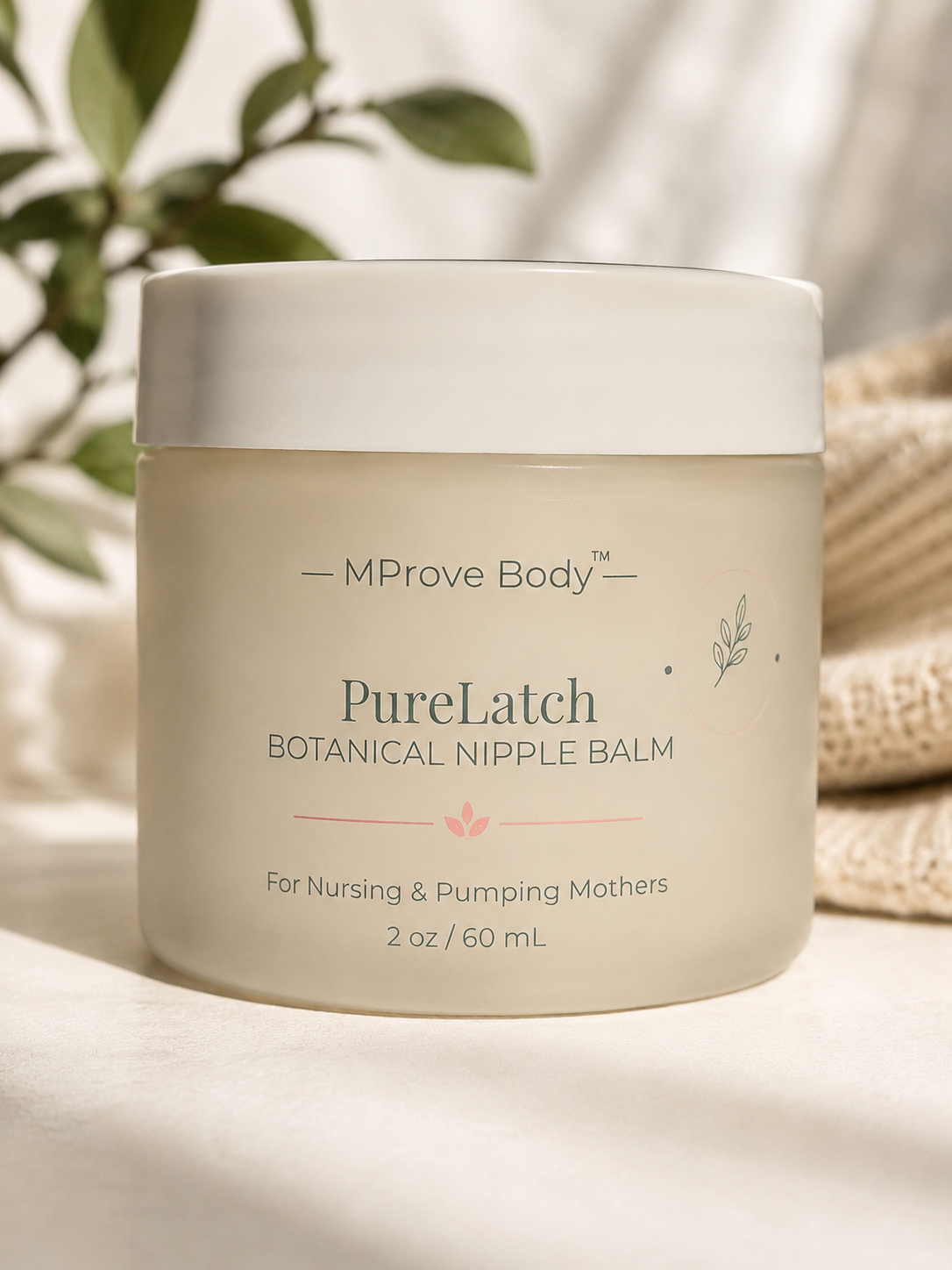
Tender, dry skin during nursing is common, and the product you reach for should be one you can explain ingredient by ingredient. MProve Body formulates with that standard in mind: OB/GYN-formulated, developed from the ground up, and built for pregnancy and postpartum skin.
Yes. Plant-based does not mean reaction-free. Botanical oils, herbal extracts, and essential oils can trigger contact dermatitis in some people, and a balm labeled hypoallergenic can still cause irritation. Stop using a balm if you notice redness, swelling, itching, or a rash that spreads beyond the application area, and speak to your clinician if symptoms persist.
It depends on the balm. Balms with added fragrance, essential oils, or unfamiliar preservatives are a different story, and some parents prefer to wipe those off before a feed. Check the product's own use instructions rather than assuming, and if the label says nothing, ask the manufacturer directly.
Start with the full ingredient list, not the front-of-pack claims. Look for a short, recognizable list of plant oils and butters, no added fragrance, and a clear statement that the product is designed for nursing use. Confirm whether it is lanolin-free if you want to avoid animal-derived ingredients, and check for any third-party certification. If a brand cannot tell you what is in the formula or why, that is your answer.


