Your cart is empty
Tax included and shipping calculated at checkout
Drawer menu
Tax included and shipping calculated at checkout

Last Updated: October 28, 2026
Quick Summary
To choose the best nipple balm, check your skin type and sensitivities first, then read the ingredient list for lanolin, added fragrance, essential oils, botanical extracts, nut oils, vitamin E, and preservatives. Patch-test any new balm on your inner forearm for 24 hours before applying it to nipple skin.
Learning how to choose the best nipple balm starts with one question: what is your skin actually doing right now? A balm that suits dry, tight skin may feel wrong on skin that is already raw. This guide from MProve Body walks through the checks that matter before you buy.
Nipple balm is a topical product used on the nipple and areola during breastfeeding.
Here is what most guides get wrong. They rank products by popularity.
Start by noting three things:
Below, we cover ingredients, safety, texture, and when to call a professional instead of reaching for another tin.
Read the ingredient list the way you would read a food label. The goal is not to find the most "natural" label.
A plant base is not automatically gentler. Coconut oil, for example, can clog pores for some users, and olive oil is not ideal for everyone with sensitive skin. The base matters less than whether your skin tolerates it.
Before you buy, run the label against this list:
For a deeper look at what makes a cream safe during nursing, read safe nipple cream for breastfeeding. And if you are weighing whether clean labels justify the cost, this breakdown of non-toxic nipple cream answers that directly.
Lanolin comes from sheep wool. So why do some people need to avoid it?
PureLatch, for example, uses olive oil, coconut oil, shea butter, cocoa butter, sunflower oil, and jojoba oil, and it is lanolin-free by design.
Safety comes down to what is in the balm. Ask your own clinician what they prefer for your baby, especially in the early weeks.
PureLatch | Botanical Nipple Balm →
At MProve Body, our balm is OB/GYN formulated.
| Feature | Cream | Balm |
|---|---|---|
| Texture | Light, water-based | Rich, oil-based |
| Absorbs | Fast | Slowly |
| Best for | Daytime, mild dryness | Cracks, night feeds |
| Residue | Minimal | Noticeable |
| Reapply | More often | Less often |
Application is where most guides stop at "apply as needed."
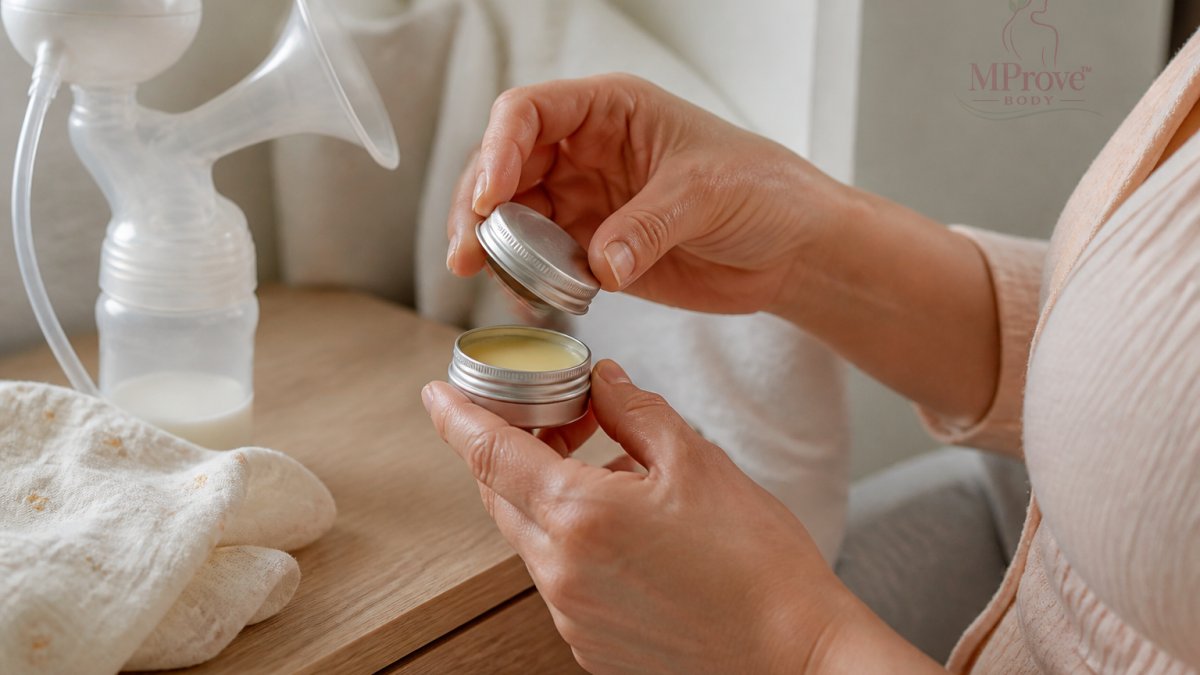
Start with a pea-sized amount per nipple. A little goes a long way: a thick layer does not speed healing and can increase residue on pads and pump parts. If skin still feels tight after the balm settles, add a second thin layer rather than a heavy one.
For fuller application and routine guidance, see this practical guide to safe nipple care.
This safe nipple care guide for breastfeeding covers damaged skin and when to seek help in more detail.
Choosing well comes down to your skin, your sensitivities, and your routine.
PureLatch is our botanical nipple balm, made with olive oil, coconut oil, shea butter, cocoa butter, sunflower oil, jojoba oil, marshmallow, chamomile, and vitamin E. It is lanolin-free and OB/GYN formulated.

Best for: nursing parents who want a plant-based, lanolin-free balm.
Look at the ingredient list first. A short, transparent ingredient list is easier to screen for anything you have reacted to before.
It depends on the formula. When in doubt, ask your midwife, health visitor, or lactation consultant, and check the manufacturer's instructions rather than assuming.
A balm can soften dry, flaky skin and create a barrier that reduces friction against clothing and pump flanges, which many mothers find soothing. It will not fix cracked nipples caused by a shallow latch or poor pump fit, so pair balm use with a latch check from a lactation consultant. Apply a small amount after each feed or pumping session and give the skin time to recover between sessions.
PureLatch is described as designed for pregnancy and postpartum care.
Tender skin in the early weeks is common, and finding a balm that fits your body should not add to the load. MProve Body formulates each product from the ground up with a board-certified OB/GYN, using ingredient selection shaped by clinical practice and chemistry. PureLatch brings that approach to nipple and areola care, with a plant-based barrier that moisturizes, soothes, and protects through pregnancy and postpartum. Get started with MProve Body and give tender skin the care it needs.


