Your cart is empty
Tax included and shipping calculated at checkout
Drawer menu
Tax included and shipping calculated at checkout

Last Updated: November 13, 2026
Quick Summary
To check if makeup is safe during pregnancy, read the full ingredient list and scan the first five ingredients for retinoids, hydroquinone, salicylic acid, and fragrance. Match the product type to your exposure, since leave-on, eye, and lip products matter more than rinse-off ones.
Learning how to check if makeup is safe during pregnancy starts with one fact: your skin is not the same skin it was nine months ago. Blood flow rises, oil production shifts, and your skin barrier becomes more reactive, so products that never caused a problem can suddenly sting, clog pores, or leave a red patch behind. Our guide on what skincare to avoid during pregnancy covers the companion list of ingredients to limit in your routine.
Here is the part most guides skip. The question is rarely "is this ingredient toxic?" It is "how much, how often, and where?"
Pregnancy changes how skin behaves in ways you can feel before you can explain them. Some women report sensitivity they never had before, along with breakouts, dryness, and a heightened sense of smell.
A common mistake is assuming a product is fine because it worked for years. In practice, your skin's tolerance has moved. Patch testing a small area before full application is the simplest protection you have, and it costs nothing.
You can screen most makeup in about five minutes with a repeatable routine. The goal is not a chemistry degree, but a fast, consistent way to spot the ingredients that matter and know what to do when a name is unclear.
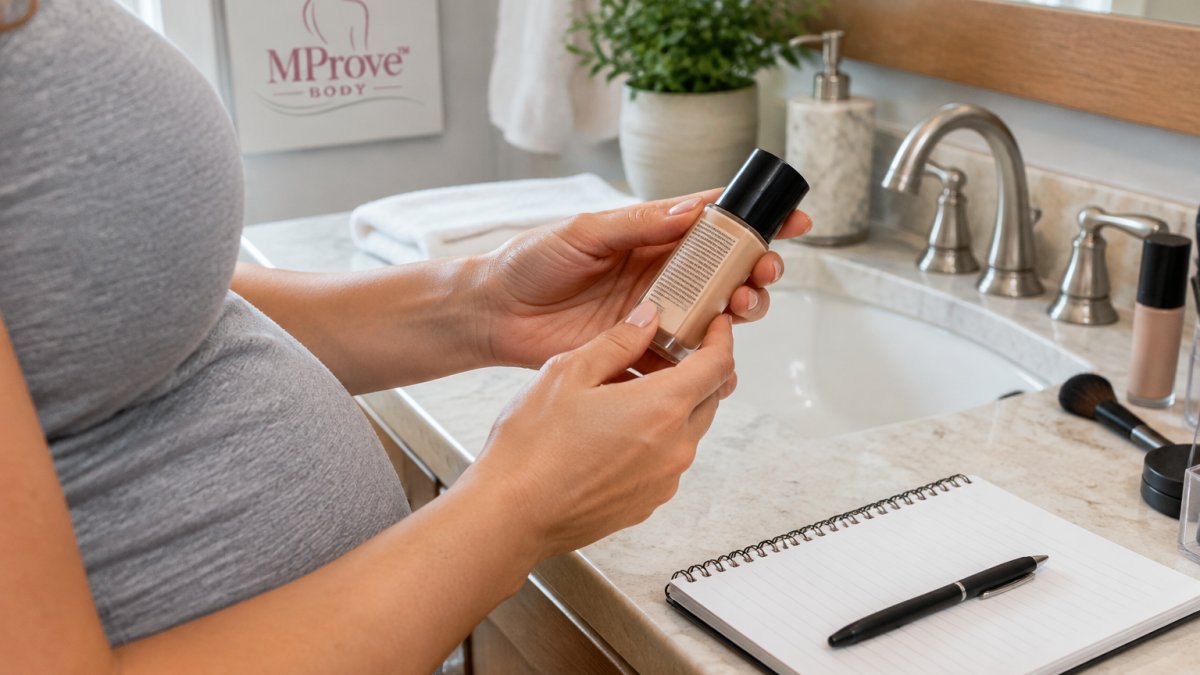
Incomplete labels are common and not automatically a red flag. Some brands list ingredients only on the carton, and some use trade names instead of the standard INCI name. The problem is when you cannot find the list at all.
A practical workflow for an unclear ingredient:
A product labeled "fragrance-free" may still contain other scent-related ingredients, so read the full list rather than trusting the front of the package.
Some exposure routes are specific to makeup and easy to overlook:
The ingredients to avoid during pregnancy in makeup fall into a short, memorable list. For a broader framework on choosing safe pregnancy skincare ingredients and applying an avoid-list to your own products, see our companion article. None are automatic emergencies, but each is worth limiting or skipping while pregnant.
Most makeup ingredients are not the problem. Mineral pigments, dimethicone, glycerin, and zinc oxide are widely used and generally well tolerated. Titanium dioxide and zinc oxide are common in mineral foundations and sunscreens.
If you need safe swaps for products you are retiring, our guide on choosing skincare alternatives for sensitive pregnancy skin walks through how to replace an irritating product without losing the function you wanted.
| Ingredient | Common Use | General Guidance |
|---|---|---|
| Retinoids (retinol, retinyl palmitate) | Anti-aging foundations, concealers | Avoid in leave-on makeup |
| Hydroquinone | Brightening concealers, serums | Avoid; ask a clinician |
| Salicylic acid | Acne primers, spot treatments | Limit; rinse-off is lower exposure |
| Fragrance / parfum | Most cosmetics | Patch test; many skip it |
| Zinc oxide, titanium dioxide | Mineral foundation, sunscreen | Generally well tolerated |
| Glycerin, dimethicone | Moisturizing base | Generally well tolerated |
Risk from a cosmetic ingredient depends on three things: how much, how it reaches you, and how often. A trace amount in a lipstick applied twice a week is a different scenario from a leave-on cream used daily across a large area.
Dose. Cosmetic ingredients are often present at low concentrations, and the amount reaching the bloodstream through intact skin is generally limited.
Route. Skin absorption varies by body site and skin condition.
Frequency. Daily use of a small exposure adds up over months.
This is where most ingredient lists online fall short. They label a substance "unsafe" without saying at what dose or by what route.
Not every ingredient warning carries the same weight. It helps to separate established guidance from limited or inconclusive evidence so you can interpret conflicting advice.
A common pattern is for readers to treat every flagged ingredient as equally dangerous. A more useful habit is to ask: what is the evidence, at what dose, by what route, and how often am I exposed?
If you used a product with a flagged ingredient, a calm, practical response pathway helps more than a search spiral.
Watch out: stopping a product is not a substitute for medical advice if you have symptoms, and a single application is not a reason to panic. The goal is to match the response to the actual exposure.
A pregnancy-safe makeup checker is a screening tool, not a verdict.
What most reviews miss is how often the database is incomplete. A product with a partial ingredient list may score "safe" simply because the checker never saw the flagged ingredient.
If you want a practical walkthrough of verifying products with a checker, our pregnancy safe skincare checker guide shows the step-by-step process, including how to handle products that return no result.
The best website to check if products are safe for pregnancy is one that shows its sources and dates. Look for a database that lists the full ingredient set, names the authority behind each rating, and updates its entries.
Use this checklist before you trust any checker:
If a site answers "no" to two or more of these, treat its green checkmark as a hint, not a guarantee.
No brand is universally "safe," and any list claiming otherwise is oversimplifying. What separates a better choice is transparency: a full ingredient list on the packaging, clear INCI names, and a willingness to answer questions about the formula.
When you compare makeup brands safe for pregnancy, weigh these factors:
MProve Body products are formulated by a board-certified OB/GYN with a background in chemistry, and are developed from the ground up rather than selected from a manufacturer's catalog.
First, do not panic. A single application of a product containing a flagged ingredient is unlikely to cause harm, and the most common outcome is skin irritation rather than anything systemic.
Call your OB/GYN or midwife if you notice a spreading rash, swelling, or any symptom that worries you. For non-urgent questions, you can contact our team and we will help you read the label.
Sorting safe makeup from questionable makeup during pregnancy comes down to a habit, not a perfect list.
No brand is blanket-safe, because formulas change and one product line can differ from another. Instead of trusting a name, check each product's ingredient list against your avoid list and look for brands that publish full ingredient disclosure and are formulated with pregnancy in mind. A brand developed with clinical input, such as MProve Body's OB/GYN-formulated range, can be a reasonable starting point, but you should still read the label on the specific item you buy.
Yes, as a first pass, not a final answer. Checker tools and databases are useful for flagging retinoids, hydroquinone, and high-concentration salicylic acid, but they often lag behind reformulations and may not list every ingredient. Use the app to shortlist products, then confirm against the physical label. If the app and the label disagree, trust the label and ask your healthcare professional about anything unclear.
Ask when the ingredient is on your avoid list, when the label is incomplete, or when you have a skin condition such as eczema or rosacea that makes irritation more likely. Bring the actual product or a photo of the ingredient list so the conversation is specific. For routine products with well-documented ingredients, label-checking at home is usually enough, and your provider can confirm anything you are unsure about.


