Your cart is empty
Tax included and shipping calculated at checkout
Drawer menu
Tax included and shipping calculated at checkout

Last Updated: October 26, 2026
Quick Summary
Skincare alternatives sensitive skin during pregnancy require fragrance-free formulas with barrier-supporting ingredients like calendula, rooibos, hyaluronic acid, and niacinamide at 2-3% concentration. Avoid retinoids, high-concentration salicylic acid, essential oils, and fragrance compounds, then patch test each new product for 24-72 hours before full use.
Pregnancy transforms your skin. Hormonal shifts increase blood flow, boost oil production, and can trigger inflammation that wasn't there before. For women with sensitive skin, products that worked before pregnancy may now cause irritation, redness, or unexpected reactions, which is why exploring skincare alternatives sensitive skin requires careful consideration. Discover a comprehensive safe routine guide tailored to your changing skin.
The challenge is understanding which ingredients your changing skin can tolerate and which cross into risky territory. Many expectant mothers learn this the hard way, switching to a "natural" alternative only to experience flare-ups that leave their skin more compromised than before.
This is where strategic selection matters. The goal isn't to strip your routine to nothing, but to rebuild it with formulas that support your skin's new reality without triggering sensitivity.
During pregnancy, your skin barrier weakens. Use a pregnancy skincare checker to verify products are actually safe before you commit to them. Hormonal fluctuations increase transepidermal water loss, meaning moisture escapes more easily. This is why many pregnant women experience dryness, even if they had oily skin before.
Your skin also becomes more reactive to common irritants. Fragrances, essential oils, and preservatives that never bothered you can now cause inflammation. This is a normal physiological shift, and understanding it helps you choose which skincare alternatives sensitive skin requires for your situation.
The skin barrier is your skin's defense system. When compromised, irritants penetrate deeper and beneficial ingredients don't absorb as effectively. During pregnancy, this barrier needs hydration and protection, not aggressive actives.
Many women add more products when sensitivity increases. The opposite works better: simplify your routine, focus on barrier repair, and introduce new products one at a time so you can see what your skin can handle.
American Academy of Dermatology guidance on pregnancy skin changes
Fragrance is the leading cause of contact dermatitis in skincare products. During pregnancy, when your skin barrier is already compromised, fragrance becomes an unnecessary risk.
Fragrance-free and unscented are not the same thing. Unscented products may still contain fragrance compounds masked by other scent molecules; fragrance-free means none were added at all. For sensitive skin during pregnancy, fragrance-free is the safer choice.
Even "natural" fragrances, essential oils and plant extracts, can trigger reactions. Lavender, chamomile, and citrus oils are common culprits: pleasant-smelling but still volatile compounds that can irritate inflamed skin.
Your nose doesn't determine safety. A product can smell mild and still contain fragrance levels high enough to cause problems, so reading the ingredient list beats the scent test.
Fragrance-free products often signal quality through texture, packaging, or visible ingredients instead. That shift helps you focus on what matters: efficacy and safety, not marketing appeal.
Contact Dermatitis Society research on fragrance sensitivity
When choosing skincare alternatives for sensitive skin during pregnancy, the goal is not just to avoid known irritants but to match formulas to your specific sensitivity profile. Learn how to choose safe pregnancy skincare ingredients that work for your skin type. Most top-ranking guides list calendula and rooibos as gentle staples, but they rarely explain which preservatives, emulsifiers, or carrier oils trigger reactions in different people.
Calendula is a soothing botanical that reduces inflammation and supports barrier repair. It appears in many pregnancy-safe balms and creams, but the concentration and extraction method matter. CO2-extracted calendula retains more plant sterols than alcohol-based tinctures, which can sting compromised skin. If you are comparing alternatives to Earth Mama's calendula-based products, look for calendula extract listed near the middle of the ingredient deck rather than at the very end, where it may be present only as a token amount.
Rooibos is a gentle antioxidant that calms without stimulating. Unlike green tea or citrus extracts, rooibos does not contain caffeine or high levels of alpha-hydroxy acids, making it suitable for reactive skin. It pairs well with oat kernel extract and bisabolol in barrier-repair formulas.
Plant-derived oils such as jojoba, sunflower, and olive oil provide hydration and barrier support. Jojoba's wax ester composition closely mimics human sebum, so it absorbs without heavy residue. Coconut oil, however, can be comedogenic and may trigger folliculitis on the chest or back, patch test carefully if you're prone to clogged pores.
Shea butter and cocoa butter are rich emollients that create a protective layer, especially helpful for chapped nipples and stretched abdominal skin. Shea is not a latex derivative, though some people with latex allergy also react to certain tropical butters, introduce one at a time.
Hyaluronic acid holds water in the skin without irritation risk and remains safe throughout pregnancy. For sensitive skin, choose a low-molecular-weight serum layered under a fragrance-free moisturizer rather than a high-concentration formula that can draw water out of the skin in dry climates.
Niacinamide (vitamin B3) strengthens the barrier and reduces inflammation. It's safe during pregnancy, but concentrations above 5% can cause flushing in sensitive individuals, start with 2-3% if it's new to you.
Vitamin E is a gentle antioxidant common in nipple balms and stretch mark formulas. It supports elasticity without risk, but avoid synthetic dl-alpha-tocopherol if you react to cosmetic preservatives; look for mixed tocopherols from sunflower or soy.
Ingredients to avoid or approach with caution:
PureLatch | Botanical Nipple Balm →
Preservatives to watch: Phenoxyethanol is generally well tolerated, but methylisothiazolinone (MI) and methylchloroisothiazolinone (MCI) are common allergens banned in some countries for leave-on products. If you've reacted to "natural" products before, check for these.
Emulsifiers and surfactants: Sodium lauryl sulfate (SLS) and sodium laureth sulfate (SLES) can strip the skin barrier. Gentler alternatives include coco-glucoside, decyl glucoside, and sodium cocoyl isethionate.
American Contact Dermatitis Society ingredient screening guidance
These ingredients are considered safe and beneficial for sensitive pregnancy skin, while others should be avoided entirely.
| Ingredient | Safe or Avoid | Why It Matters for Pregnancy Skin |
|---|---|---|
| Calendula | Safe | Reduces inflammation and supports barrier repair |
| Rooibos | Safe | Gentle antioxidant without caffeine or acids |
| Jojoba oil | Safe | Mimics human sebum and absorbs without residue |
| Hyaluronic acid | Safe | Holds water in skin without irritation risk |
| Niacinamide | Safe | Strengthens barrier; use 2-3% concentration |
| Retinoids | Avoid | Contraindicated during pregnancy |
| Salicylic acid | Avoid | High concentrations above 2% not recommended |
| Essential oils | Avoid | Volatile compounds trigger contact dermatitis |
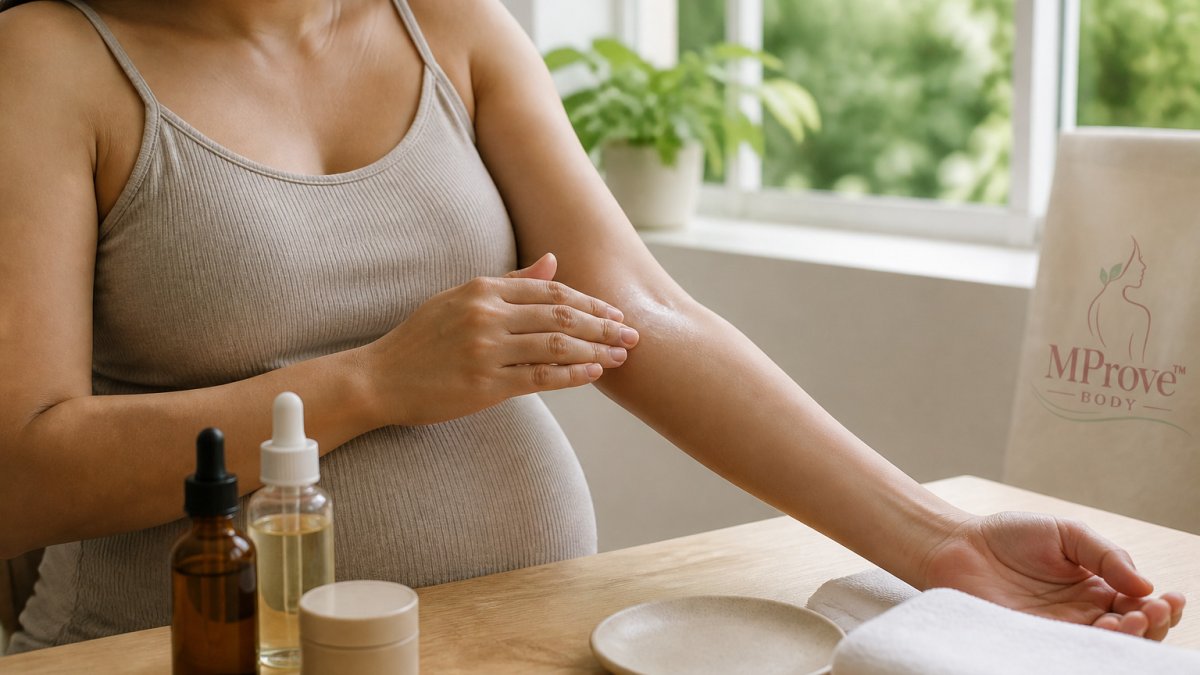
Step 1: Choose the right test site.
Step 2: Apply a small amount, but not too small.
Step 3: Leave it on for 24 hours without washing. Don't cover the area with a bandage unless your dermatologist instructs it, occlusion can increase penetration and cause irritation that wouldn't occur in normal use. Avoid applying other products to the site.
Step 4: Check at 24 hours, then again at 48 and 72 hours. This is the step most people skip, yet allergic reactions often peak at 48-72 hours. If you see redness, itching, burning, or small bumps at any point, stop using the product; a reaction appearing after 48 hours is more likely allergic than irritant, so avoid that ingredient going forward.
Step 5: If no reaction occurs, test on a larger area. Apply the product to your jawline or forehead for another 48 hours. This second-stage test catches reactions that only appear on thinner or more exposed skin.
Step 6: Introduce only one new product at a time. If you add a cleanser, a moisturizer, and a balm simultaneously and react, you will not know which one caused the problem. Wait at least one week between new products.
What "hypoallergenic" really means:
Irritant vs. allergic reactions:
Keep a log:
When to skip patch testing:
American Academy of Dermatology patch testing guidance
Finally, many women wait too long to switch. Understand what skincare to avoid during pregnancy so you can make confident switches to sensitive-skin alternatives. If a product is causing irritation, stop using it, continuing in hopes it will improve wastes time and damages your barrier further.
Cleansing: Use a fragrance-free, non-stripping cleanser morning and night. Avoid hot water, which increases irritation. Lukewarm water is gentler on sensitive skin.
Moisturizing: Apply moisturizer while your skin is still slightly damp. This locks in hydration more effectively than applying to completely dry skin.
Targeted care: If you're breastfeeding or planning to, consider a nipple balm like PureLatch Botanical Nipple Balm. It's formulated with plant-based oils, shea butter, marshmallow, and chamomile. Apply a small amount after nursing or pumping.

If stretch marks are a concern, a hydrating cream like StriaeMend Stretch Mark Therapy Cream supports skin elasticity and hydration. Its lightweight formula glides over larger areas without heaviness.
Safe pregnancy skincare for sensitive skin avoids potential irritants like synthetic fragrances, essential oils, and harsh preservatives. Look for fragrance-free formulas with minimal ingredients, plant-derived components like calendula and chamomile, and products specifically formulated for pregnancy. Ingredients like hyaluronic acid, shea butter, and niacinamide support the skin barrier without triggering reactions. Always check product labels for paraben-free and lanolin-free claims if you have known sensitivities.
Yes. Hormonal shifts during pregnancy can increase skin sensitivity and reactivity to products you previously tolerated. This happens because pregnancy hormones affect how your skin barrier functions and how your immune system responds to irritants. Products that worked before pregnancy may suddenly cause redness, itching, or dryness. This is why patch testing new products becomes even more important during pregnancy, and why switching to gentler, fragrance-free formulas often helps during this window.
No. Fragrance-free means no scent has been added intentionally. Unscented products may contain masking fragrances that neutralize other odors but can still trigger sensitivity reactions. For pregnancy and sensitive skin, fragrance-free is the safer choice because it eliminates both obvious scents and hidden fragrance chemicals. Always read ingredient lists carefully, if you see 'fragrance,' 'parfum,' or 'essential oils,' the product is not truly fragrance-free, even if it smells neutral.
Stop using the product immediately and rinse the affected area with lukewarm water. Avoid applying other new products for 24-48 hours to let your skin settle. If the reaction is mild (slight redness or itching), monitor it closely. If redness, swelling, severe itching, or a rash develops and doesn't improve within a few hours, contact your OB/GYN before using any new skincare. Always patch test on a small area first, and introduce only one new product at a time so you can identify what caused the reaction.
Navigating pregnancy skincare shouldn't mean choosing between efficacy and safety. Your skin needs formulas that respect its changing barrier while delivering real results. MProve Body creates products specifically for this challenge, combining clinical expertise with ingredients chosen for both safety and effectiveness during pregnancy and postpartum recovery.


