Your cart is empty
Tax included and shipping calculated at checkout
Drawer menu
Tax included and shipping calculated at checkout

Last Updated: September 29, 2026
Hormonal acne is breakouts driven by changes in androgen and progesterone levels, and pregnancy amplifies both. Rising hormones ramp up sebum production, which combines with dead skin cells to block pores, a process clinicians call follicular obstruction. That is why breakouts often appear along the jawline and chin in the first trimester, even in women who rarely had acne before.
If you are searching for how to treat hormonal acne during pregnancy, the short answer is this: you treat it with a small, well-verified list of topical ingredients, you avoid retinoids and most oral options, and you accept that improvement usually arrives in the second trimester. At MProve Body, every formulation starts from that constraint, which is why our products are developed from the ground up by a board-certified OB/GYN.
The frustration is real, and it is not cosmetic vanity. Acne during pregnancy affects how women feel in their own skin at a moment when their body is already changing fast.
Azelaic acid is the first-line topical for pregnancy acne, typically used at 15-20% strength, because it reduces skin inflammation and unclogs pores without the safety concerns attached to retinoids. It is also one of the few actives with a long, well-documented safety profile in pregnancy.
Benzoyl peroxide comes next. Applied at 2.5-5% it kills acne-causing bacteria on the skin surface, and only a small fraction is absorbed systemically. The trade-off is dryness and bleaching of towels and pillowcases, which surprises almost everyone the first week.
For stubborn inflammatory papules, a dermatologist may add a prescription topical antibiotic such as clindamycin or erythromycin. These are usually combined with benzoyl peroxide to reduce bacterial resistance.
Niacinamide deserves a mention for a different reason: it calms redness and supports the skin barrier, which matters when pregnancy has already made your skin more sensitive.
Ingredient |
Typical Use |
Best For |
Watch Out For |
|---|---|---|---|
Azelaic acid |
15-20%, twice daily |
First-line therapy, all acne types |
Mild tingling in week one |
Benzoyl peroxide |
2.5-5%, once daily |
Inflammatory papules |
Dryness, bleached fabric |
Clindamycin |
Prescription, once daily |
Stubborn lesions |
Use with benzoyl peroxide |
Erythromycin |
Prescription, once daily |
Antibiotic alternative |
Same resistance caveat |
Niacinamide |
2-5%, twice daily |
Redness, barrier support |
Rare irritation |
Retinoids are the clearest no. Oral isotretinoin and topical tretinoin are teratogenic, meaning they can cause birth defects, and they must be stopped before conception under medical supervision. This is not a grey area.
High-percentage salicylic acid peels and oral tetracyclines such as doxycycline also sit on the avoid list. Hormonal therapies including spironolactone and combined oral contraceptives are off the table for the same reason, even though they are standard acne treatment outside pregnancy.
What about low-strength salicylic acid in a face wash? Many clinicians permit a brief-contact 2% cleanser, but this is a conversation to have with your own OB/GYN or dermatologist rather than a decision to make from a blog post. The FDA guidance on medication use in pregnancy is a useful starting point for understanding how risk categories are assigned.
Most pregnancy acne improves by the end of the first trimester and clears noticeably in the second, as hormone levels stabilise. For a smaller group, breakouts persist through the third trimester and flare again in the first weeks postpartum before settling.
The postpartum transition catches people off guard. Estrogen and progesterone drop sharply after delivery, and androgens are relatively unopposed, so oil production can spike just as sleep deprivation peaks. If you are breastfeeding, that hormonal picture shifts again, and lactation-safe topical options remain the sensible default.
The honest answer is that there is no fixed timeline. Some women see clear skin by week 14; others deal with flares until their cycles return to normal, which can take months.
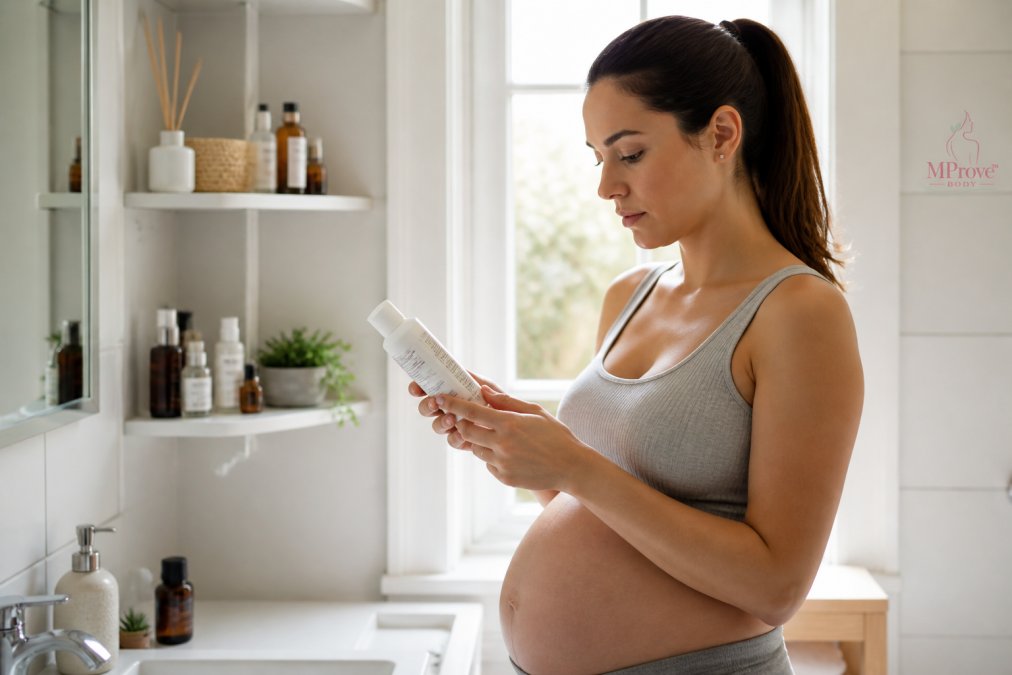
A pregnancy skincare routine for breakouts should be short: a gentle cleanser, one active, a light non-comedogenic moisturiser, and mineral sunscreen. Four steps, twice a day, outperforms a ten-step routine that irritates your barrier. The goal is not to attack acne from every angle, it is to support your skin while one or two proven actives do the work.
Here is the sequence that works for most people, with the reasoning behind each step:
How to layer actives without irritation
If you are using both azelaic acid and benzoyl peroxide, alternate them: azelaic acid in the morning, benzoyl peroxide at night, or vice versa. Do not apply them at the same time, the combination can be too drying and may cause redness or peeling. Niacinamide can be layered with either active; it is generally well tolerated and can help calm the irritation that actives sometimes cause.
Adjusting for trimester changes
Your skin may behave differently in each trimester. In the first trimester, when oil production is ramping up, you may need the full routine. In the second trimester, many women find their skin calms down and can reduce to just cleanser, moisturiser, and sunscreen on some days. In the third trimester, oiliness can return, so you may reintroduce your active if you had paused it.
What to do when your skin reacts
Acne during pregnancy carries a psychological weight that most clinical guides skip entirely. You are already managing prenatal appointments, body changes, and often a full workload, and then your face breaks out at the exact moment you expected to feel glowing.
Book a dermatological consultation if your acne is nodular or cystic, if it is leaving scars, or if six weeks of consistent azelaic acid or benzoyl peroxide has not helped. Those three triggers are the practical cutoff, and waiting longer mostly buys you more marks. But there are other situations where seeing a specialist earlier can make a real difference.
Specific triggers to see a dermatologist
How to prepare for your appointment
What to expect from a dermatologist during pregnancy
Budget-friendly options
The postpartum transition
Acne often flares during the first trimester as progesterone and androgens rise sharply, increasing sebum production. Some women notice a second wave in the third trimester. The pattern varies widely, and not every pregnancy follows the same timeline.
Retinoids, including tretinoin and isotretinoin, are teratogenic and should be avoided. High-dose salicylic acid peels, oral tetracyclines, and most prescription retinoids are also off-limits. Always confirm any active ingredient with your OB/GYN or dermatologist before use.
Research does not consistently show that fetal sex determines acne severity. Hormonal shifts in the mother drive most pregnancy breakouts, not the baby's gender. If you notice a pattern, it is more likely tied to your own hormonal balance than the sex of your baby.
Some botanical ingredients, like niacinamide and gentle plant-derived cleansers, can calm skin inflammation. However, 'natural' does not always mean pregnancy-safe. Tea tree oil and certain essential oils can irritate sensitive skin, so patch-test first and check with your prenatal care provider.


