Your cart is empty
Tax included and shipping calculated at checkout
Drawer menu
Tax included and shipping calculated at checkout

Last Updated: November 12, 2026
Quick Summary
The best postpartum recovery products are formulated care items that keep vulnerable skin hydrated, reduce friction and dryness, and make the daily routine of recovery easier to manage. Build your kit by category rather than by brand: skin recovery, nipple and breastfeeding comfort, hair and scalp care, and perineal or C-section comfort.
Postpartum recovery products are formulated care items that support skin, tissue, and comfort needs in the weeks and months after birth. They do not speed healing or replace medical care. What they do is keep vulnerable skin hydrated, reduce friction and dryness, and make the daily routine of recovery a little easier to manage.
At MProve Body, we build our range around that modest but real job. Every formula is created by a board-certified OB/GYN, and each one is developed from the ground up rather than picked from a manufacturer's catalogue.
Here is the honest framing: postpartum recovery products fall into a few practical categories, and most mothers only need some of them. Below, we break down each category, what it helps with, and how to decide what belongs in your kit. The guidance from the NHS on caring for yourself after birth is a useful baseline for what recovery actually involves.
A postpartum essentials list for mom comes down to four categories: skin recovery, nipple and breastfeeding comfort, hair and scalp care, and perineal or C-section comfort. Build your kit by category, not by brand, and you will avoid buying three versions of the same thing.

If you want a ready-made starting point to check your own kit against, our guide to must-have motherhood essentials for postpartum recovery walks through each category in more detail.
Vaginal birth recovery focuses on keeping the body comfortable in the first weeks. Skincare enters the picture for the abdomen and breasts, where skin has stretched and often feels tight and dry.
A common mistake is over-buying in week one. Most mothers need less than they think.
For stretch mark care specifically, look for a texture you will actually use every day. A lightweight cream-serum texture is designed to glide over larger areas of stretching skin without a heavy or greasy residue. If you are assembling first-weeks supplies, our guide on postpartum stretch mark care and what to include in your bundle covers how to fold that step into your kit.
Postpartum essentials for mom C-section recovery prioritise the incision site first and everything else second. Follow your surgical team's instructions for the scar area, and ask your clinician before applying anything to a healing incision.
Once your incision is closed and your clinician is happy with healing, the practical focus shifts to comfort, such as loose clothing that does not rub.
Ask your midwife or surgeon before anything goes near the incision site.
Postpartum shedding is a normal shift in the hair growth cycle, and a topical scalp oil is not a treatment for it. Hair Growth Oil is a botanical scalp infusion designed to nourish the scalp and support healthier-looking hair.
That is the straight answer, and it is worth sitting with. A scalp oil with botanical extracts can fit into a daily routine. If you are weighing whether it is worth it, our article on whether topical products can stop postpartum hair loss answers that question directly.
Choosing postpartum recovery products for sensitive skin comes down to three checks: a short ingredient list, no lanolin if you have reacted to it before, and a patch test before daily use. Reactive skin does not need more actives. It needs fewer, better-chosen ones.
If you have had a bad reaction to a product marketed as natural, the culprit is often a botanical you did not expect or a fragrance blend. Read the full list, not the front of the pack.
For readers with reactive skin, our guide to skincare alternatives for sensitive pregnancy skin walks through how to swap products without triggering a flare.
Building your recovery kit is easier when you buy by need rather than by hype. Our approach at MProve Body is to make a small number of products that each do one job properly, formulated by a board-certified OB/GYN and developed from scratch rather than sourced from a catalogue.
StriaeMend Stretch Mark Therapy Cream is our daily skin recovery pick. It combines Centella Asiatica, Hyaluronic Acid, and Niacinamide with shea and cocoa butter in a lightweight cream-serum. It is designed for use during pregnancy, after delivery, and throughout life's natural body changes.
PureLatch Botanical Nipple Balm is designed for breastfeeding comfort. It is lanolin-free and built on olive, coconut, sunflower, and jojoba oils with shea and cocoa butter, plus marshmallow and chamomile. Apply a small amount to the nipple and areola as needed, particularly after nursing or pumping.
The Signature Trio bundles StriaeMend, PureLatch, and our Hair Growth Oil, a botanical scalp infusion for postpartum shedding, protective styles, and daily scalp care.
| Product | Category | Key Ingredients | Best For |
|---|---|---|---|
| StriaeMend | Skin recovery | Centella Asiatica, Hyaluronic Acid, Niacinamide | Daily stretch mark and elasticity care |
| PureLatch | Breastfeeding comfort | Olive, coconut, jojoba oils, shea, chamomile | Nursing and pumping tenderness |
| Hair Growth Oil | Hair and scalp | Botanical oils and herbal extracts | Postpartum shedding, scalp care |
| Signature Trio | Bundle | All three above | A complete kit in one purchase |
Best for: mothers who want a small, considered kit rather than a shelf of half-used bottles. Skip if: you are looking for a perineal care range, which we do not make.
If you are building from scratch, the complete Signature Trio bundle is the simplest way to cover skin, breastfeeding, and hair in one order.
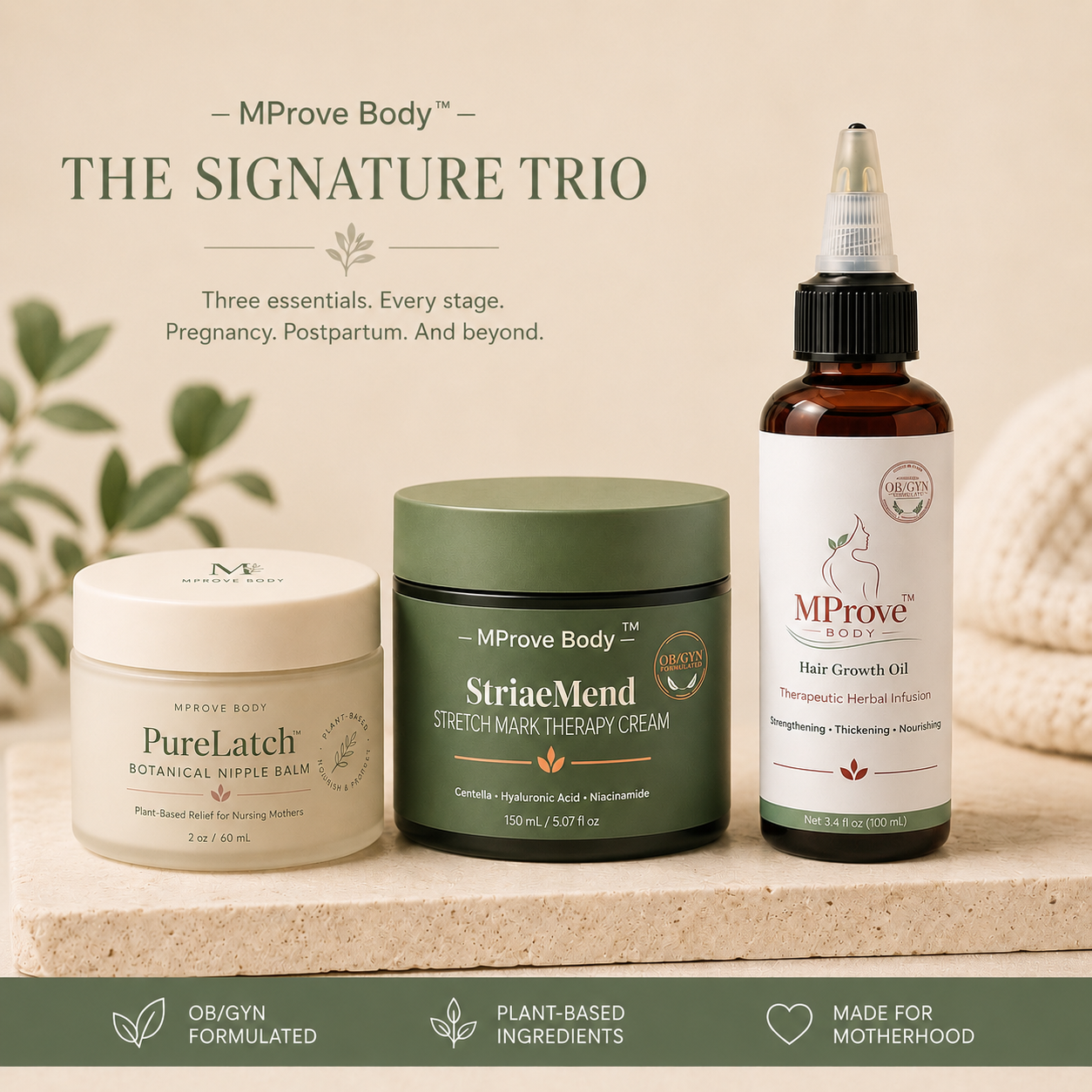
Recovery is not a test of how much you can buy. It is a matter of covering the few needs you actually have, with products that do what they claim. MProve Body formulates each product with a board-certified OB/GYN, develops every formula from the ground up, and keeps the range deliberately small so you are not choosing between twelve versions of the same cream. Start with the category you need most and add from there.
The 3-3-3 rule is a common way to pace the first weeks after birth: roughly three days in bed, three weeks around the house, and three months taking it slowly before returning to full activity. It is a guide, not a medical protocol, and it does not replace your provider's advice. Use it to set expectations with visitors and family, and to justify keeping your recovery kit within arm's reach of wherever you are resting.
Check the ingredient list for anything you would not want near your baby's mouth, and ask your lactation consultant or OB/GYN about specific ingredients. Lanolin-free botanical balms are one option for mothers who want to avoid animal-derived ingredients. If a product's label does not clearly state it is designed for pregnancy and postpartum use, treat that as a reason to ask before applying it to the nipple or areola.
Contact your provider promptly for a fever, worsening pain, heavy bleeding that soaks a pad in an hour, redness or discharge from a C-section incision, or a breast area that is hot, swollen and painful. Mood changes that feel unmanageable also warrant a call. Recovery products support comfort with dry skin, tenderness and stretching, but they are not a substitute for medical care when something feels wrong.


