Your cart is empty
Tax included and shipping calculated at checkout
Drawer menu
Tax included and shipping calculated at checkout

Last Updated: October 30, 2026
Quick Summary
Pregnancy safe skincare for dry skin is worth it when you build a short, fragrance-free routine around barrier-friendly ingredients like ceramides, squalane, hyaluronic acid, glycerin, shea butter, and niacinamide. Apply moisturizer to damp skin twice daily and skip retinoids, high-dose salicylic acid peels, and fragranced products.
Dry, tight skin is one of the most common complaints in pregnancy. Hormonal changes during pregnancy can affect oil production and the skin barrier. Women in every trimester often describe skin that was fine last month now feeling rough, flaky, and itchy by afternoon.
Blood volume rises during pregnancy too, which stretches skin over the belly, breasts, and hips. Stretched skin loses water faster and feels tighter. Add winter air, hot showers, and long days indoors, and the dryness compounds.
The good news: pregnancy safe skincare for dry skin is straightforward once you know which ingredients to skip and which to reach for. Below, we break down what to avoid, how to build a moisturizer routine, and when dryness needs a clinician's eye.
Start with what to leave on the shelf. Retinoids, including retinol and prescription tretinoin, are the clearest avoid. High-dose salicylic acid peels and oral acne drugs are also off the list.
Fragrance is the quiet offender. "Unscented" and "fragrance-free" are not the same thing, and synthetic fragrance is a top trigger for irritation on already-sensitive pregnancy skin. Essential oil blends can sting too, even when a label calls them natural.
Watch out: some "belly butter" products pair cocoa butter with fragrance or essential oils, which can irritate stretched skin rather than soothe it. For a fuller breakdown of the avoid list, read our guide to what skincare to avoid during pregnancy.
The best pregnancy safe moisturizer for dry skin is fragrance-free, thick enough to seal in water, and built on barrier-friendly ingredients. Look for ingredients such as ceramides, squalane, hyaluronic acid, glycerin, shea butter, and niacinamide, which are commonly used in dry-skin moisturizers.
Texture matters as much as the ingredient list. A heavy wax balm can feel greasy under clothes, while a lightweight cream-serum glides over a growing belly and absorbs fast. If you want a deeper walkthrough of how to vet ingredients, see how to choose safe pregnancy skincare ingredients.
A common practice is to apply moisturizer while skin is still damp after a lukewarm shower.
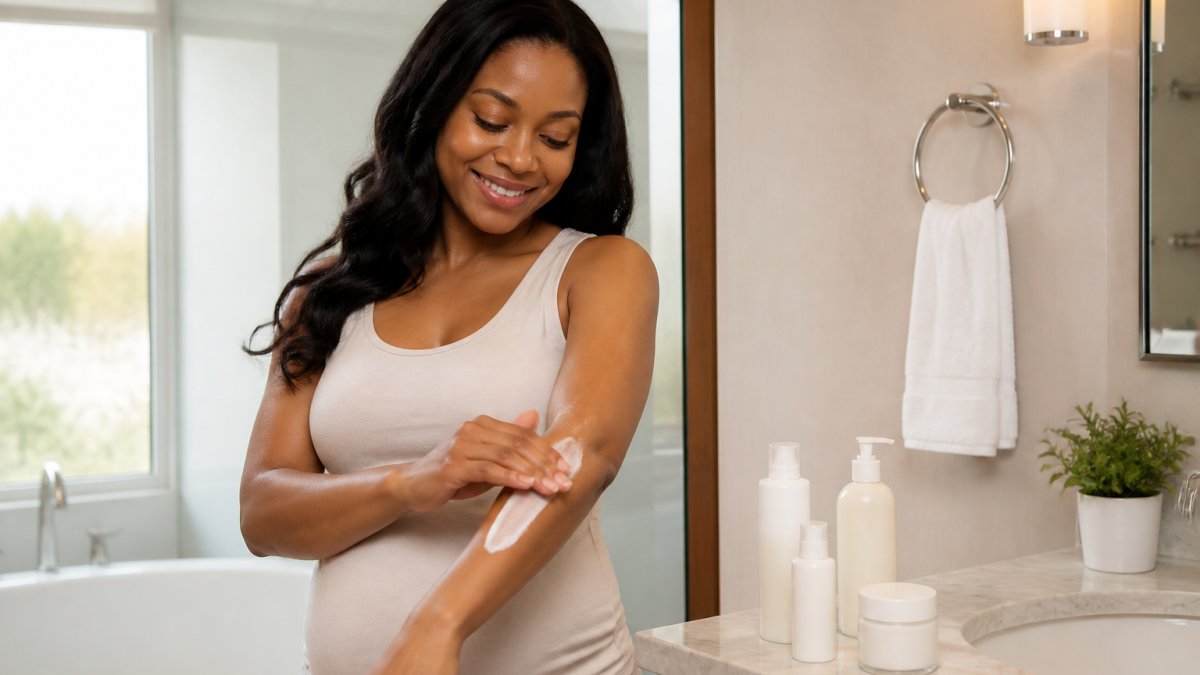
A pregnancy safe skincare routine for dry skin does not need ten steps. It needs the right five, done in the right order, twice a day. The sequence below is built around one principle: water first, oil and occlusives second. Hydrating layers pull water into the skin; a barrier cream on top keeps it from escaping. Reverse the order and you seal nothing in.
Morning (about four minutes):
Evening (about five minutes):
Dry-skin adjustments that matter more than the product list:
If you are layering a serum and a cream-serum, the thinner texture always goes first. And if a product's label is unclear about fragrance or active ingredients, leave it out until you have checked, the next section shows you how.
Here is the twice-daily sequence at a glance, with the time each step takes.
StriaeMend | Stretch Mark Therapy Cream →
| Time of day | Step | What to do |
|---|---|---|
| Morning | Cleanse | Rinse with lukewarm water or fragrance-free cream cleanser |
| Morning | Hydrate | Apply glycerin or hyaluronic acid serum on damp skin |
| Morning | Seal | Press in fragrance-free moisturizer with ceramides or squalane |
| Morning | Protect | Finish with mineral sunscreen, zinc oxide or titanium dioxide |
| Evening | Cleanse | Remove sunscreen and grime with the same gentle cleanser |
| Evening | Hydrate | Layer hydrating serum or cream-serum on damp skin |
| Evening | Seal | Lighter cream for face, thicker layer for belly and hips |
| Evening | Occlude | Thin fragrance-free balm on belly and hips if you sleep dry |
Itchy dry skin during pregnancy is often attributed to ordinary dryness, and some people find it improves with consistent moisturizing. But some itching needs a clinician's review. Itching that spreads to the palms and soles, comes with a rash, or keeps you up at night is worth a call.
A few signs to flag:
Do not self-diagnose. A clinician can help determine whether symptoms are simple dryness or a pregnancy-related skin condition.
Most pregnancy skincare advice stops at a list of ingredients to avoid. That is not enough when you are standing in a store aisle holding a bottle. What you need is a repeatable way to read the label in about a minute, and a clear sense of when the label alone cannot answer the question.
Step 1: Find the fragrance signal. Look for the words "fragrance-free," not "unscented." "Unscented" and "fragrance-free" can mean different things, so it helps to check the label carefully. Also scan for "parfum" and for essential oil blends (lavender, citrus, peppermint), natural does not mean non-irritating.
Step 2: Scan the first five ingredients. Ingredients are listed in descending order of concentration. If a retinoid, retinol, or tretinoin appears anywhere, put it back. The same goes for hydroquinone. For salicylic acid, check where it sits: a rinse-off cleanser with a low concentration is a different situation from a leave-on peel or a high-dose treatment, and that distinction is worth raising with your clinician rather than deciding from the label alone.
Step 3: Look for barrier-support ingredients. For dry skin, the useful names are ceramides, squalane, hyaluronic acid, glycerin, shea butter, niacinamide, and panthenol. A product that lists these ingredients near the top of its list may contain a higher concentration of them.
Step 4: Judge the length and the botanicals. A short ingredient list with few botanical extracts is easier to tolerate than a long one with a dozen plant oils. Botanical ingredients are not automatically gentle, and longer ingredient lists contain more items that may not suit every skin type.
Step 5: Patch-test before you commit. Apply a small amount to your inner forearm for two or three days before using it on your face or belly. This is especially worth doing with any new product introduced mid-pregnancy, when your skin's reactivity may have shifted.
If a label is vague, the ingredient list is buried behind a QR code, or the product makes claims it will not substantiate, skip it. For a step-by-step way to verify products against these criteria, use our pregnancy safe skincare checker.
For dry, stretching skin, we built StriaeMend as a silky cream-serum rather than a heavy belly butter. It combines Centella Asiatica, hyaluronic acid, and niacinamide with shea butter, cocoa butter, jojoba oil, and squalane, and is formulated to hydrate dry, stretching skin and help maintain its softness. It is OB/GYN-formulated and designed to glide over larger areas without a greasy residue.
You can shop StriaeMend stretch mark therapy cream for daily use through pregnancy and postpartum. If you are weighing whether the "OB/GYN formulated" label matters, our guide on whether OB/GYN formulated skincare is worth it walks through what to look for.

Pregnancy dryness is manageable with a short, gentle routine and the right ingredients. Start with a fragrance-free cleanser, a hydrating serum, and a barrier-supporting moisturizer, then check labels before adding anything new. You can explore MProve Body's pregnancy and postpartum skincare range for daily hydration through pregnancy and beyond.
Hyaluronic acid is a humectant, meaning it draws water into the skin, and it is often included in pregnancy-oriented skincare formulas. If your skin is dry and tight, a hyaluronic acid serum is one option some people layer under a moisturizer. As with any new product, patch test first and mention it to your clinician at your next visit if you have concerns.
Hormonal changes can affect oil production and the skin barrier, and many women notice tightness, flaking, or rough patches. Blood volume rises during pregnancy, which can also leave skin looking dull. Consistent hydration with a gentle cleanser and a fragrance-free moisturizer is a common approach.
Ask before introducing any active ingredient you have not used before, including exfoliating acids, retinoids, and high-concentration vitamin C. Also check in if dryness comes with a rash, intense itching, or skin that cracks or bleeds, since those symptoms can point to something beyond ordinary dryness. Bring the actual product label to your appointment so your provider can review the full ingredient list rather than a summary.
Ceramides are lipids that already exist in the skin, and they are commonly included in moisturizers for dry skin. Questions about any ingredient's suitability during pregnancy are best directed to a clinician. If you have sensitive skin, introduce one new product at a time so you can tell what works.


